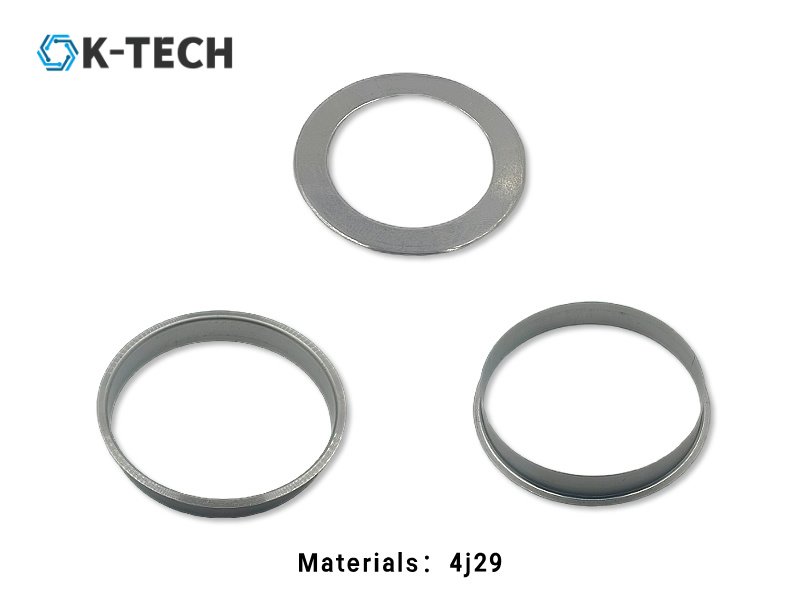
Kovar alloy is a low expansion alloy based on iron-nickel-cobalt. Its composition is strictly controlled to match the thermal expansion characteristics of glass and ceramics, and it is widely used in glass-to-metal sealing in electronic packaging, vacuum devices and other fields. Typical chemical makeup per industry standards (e.g., ASTM F-15, UNS K94610):
Main Elements (mass percentage)
- Iron (Fe): 53.0%~54.0%
As the base metal, iron provides the structural strength and magnetic foundation of the alloy. - Nickel (Ni): 29.0%
The addition of nickel significantly reduces the coefficient of thermal expansion and enhances corrosion resistance. - Cobalt (Co): 17.0%
Cobalt further optimizes thermal expansion matching and improves high-temperature stability and oxidation resistance.
Trace Elements (mass percentage, maximum value)
- Silicon (Si): 0.2%
A small amount of silicon is used for deoxidation to improve casting performance. - Manganese (Mn): 0.5%
It assists in deoxidation and enhances machinability. - Carbon (C): 0.02%~0.04%
Carbon content is strictly controlled to avoid embrittlement and ensure welding and sealing performance. - Other elements:
Aluminum (Al), magnesium (Mg), zirconium (Zr), titanium (Ti), copper (Cu), chromium (Cr), molybdenum (Mo), etc., are usually ≤0.1%~0.2% each. They exist as impurities or trace additives and have little impact on overall performance.
Key Properties and Applications
- Coefficient of thermal expansion: about 5.3~5.5 ppm/°C (20~500°C), well match with borosilicate glass( such as Pyrex), no stress cracking when temperature change.
- Mechanical properties:
The tensile strength of about 517 MPa combined with 30 % elongation makes it tough and workable, thus suitable for complex forming processes such as deep drawing and stamping. - Typical applications:
Electron tube pins, semiconductor packaging, X-ray tubes, microwave devices, and other scenarios requiring high-reliability sealing.
Production and Standards
Standard manufacturing of Kovar alloy is by vacuum melting such as VIM+VAR processes for compositional uniformity and purity in accordance with standards such as ASTM F-15 and AMS 7728. The more accurate the composition , the more consistent the thermal expansion . This is why manufacturers (Carpenter Technology, Eagle Alloys, and others) have to make sure their batches are stable, via rigorous quality control.
Comparison with Other Alloys
Kovar has a much higher cobalt content than Invar (36% Ni-Fe), so it can maintain low expansion properties over a wider temperature range. Alloy 52 (52% Ni-Fe) is less expensive, has a slightly higher coefficient of expansion, and can be used in less demanding applications.
In short, the design of Kovar alloy’s composition is the foundation of its glass-to-metal sealing. It is the exact iron-nickel-cobalt ratio and trace element control that combine to deliver its unique thermomechanical properties.