What Is Kovar and Why Does It Matter for Vacuum Viewports?
A vacuum viewport must allow optical access into a sealed chamber while maintaining a leak-tight barrier against the outside atmosphere. The central engineering challenge lies not in the window material itself, but in joining that window—typically glass, quartz, or sapphire—to a stainless steel flange without introducing stresses that cause cracks or leaks.
Kovar (ASTM F15, Chinese grade 4J29) is a nickel-cobalt ferrous alloy composed of approximately 29% nickel, 17% cobalt, and the balance iron. It was specifically developed to match the thermal expansion characteristics of borosilicate glass, enabling reliable glass-to-metal seals. Its coefficient of thermal expansion is approximately 50 × 10⁻⁷ / °C in the critical sealing range, closely matching hard glasses such as Corning 7056 and Kodial borosilicate.
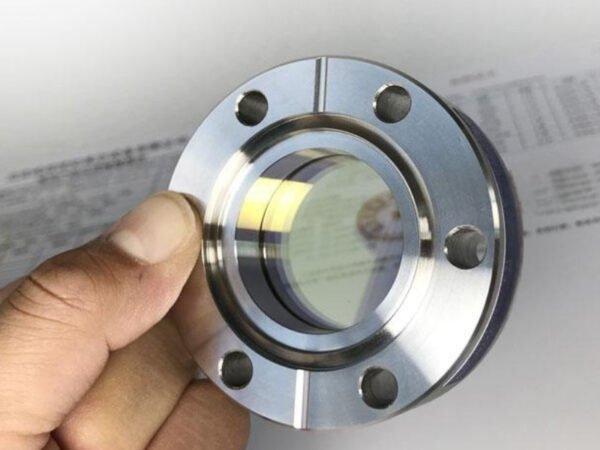
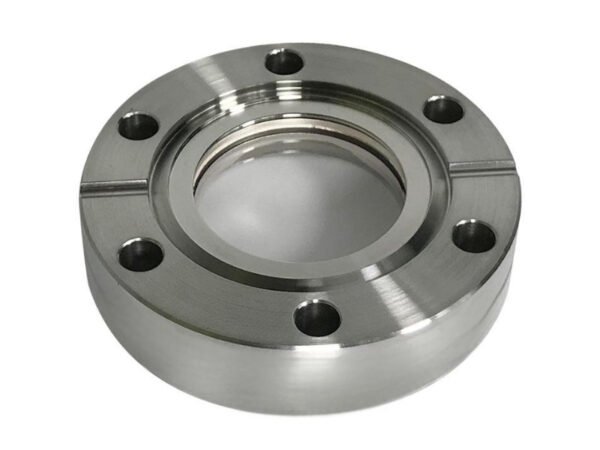
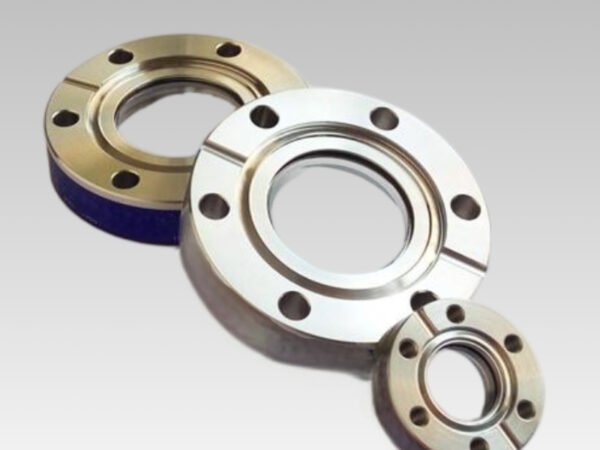
This property makes Kovar the industry-standard transition material in vacuum viewports. A typical UHV viewport is constructed by sealing a glass window to a Kovar sleeve, which is then welded to a 300-series stainless steel ConFlat flange. Without this intermediate layer, the thermal expansion mismatch between glass and stainless steel would generate stresses exceeding the fracture strength of the window during bake-out or thermal cycling.
Explore Prekovar’s Kovar Solutions →
The Thermal Expansion Matching Principle
Understanding why Kovar is indispensable requires a closer look at the numbers. Borosilicate glass used in vacuum viewports has a coefficient of thermal expansion (CTE) in the range of 3–5 × 10⁻⁶ / °C. Austenitic stainless steel (304/316L), commonly used for vacuum flanges, has a CTE of approximately 16–17 × 10⁻⁶ / °C—roughly four times that of the glass.
When a direct glass-to-steel seal is cooled from the sealing temperature (typically 800–1000°C), the steel contracts far more than the glass, placing the glass under tensile stress. Tensile stress is precisely the failure mode that causes cracks to propagate in brittle glass.
Kovar bridges this gap. Its CTE in the 20–450°C range is engineered to be nearly identical to that of borosilicate glass, allowing a “matched seal” rather than a “compression seal”. In a matched seal, the glass and metal contract at virtually the same rate during cooling, minimizing residual stress and achieving a durable, hermetic bond.
For detailed specifications on Prekovar’s vacuum viewport product line, including material options and sealing configurations, visit our product page.
View Vacuum Viewport Products →
How Kovar Is Used in a Typical Vacuum Viewport Assembly
The standard architecture of a Kovar-sealed vacuum viewport follows a three-layer construction:
- Optical window: The viewing element, typically Corning 7056 borosilicate glass, fused quartz, or synthetic sapphire. Corning 7056 is widely used because its thermal expansion behavior is specifically compatible with Kovar.
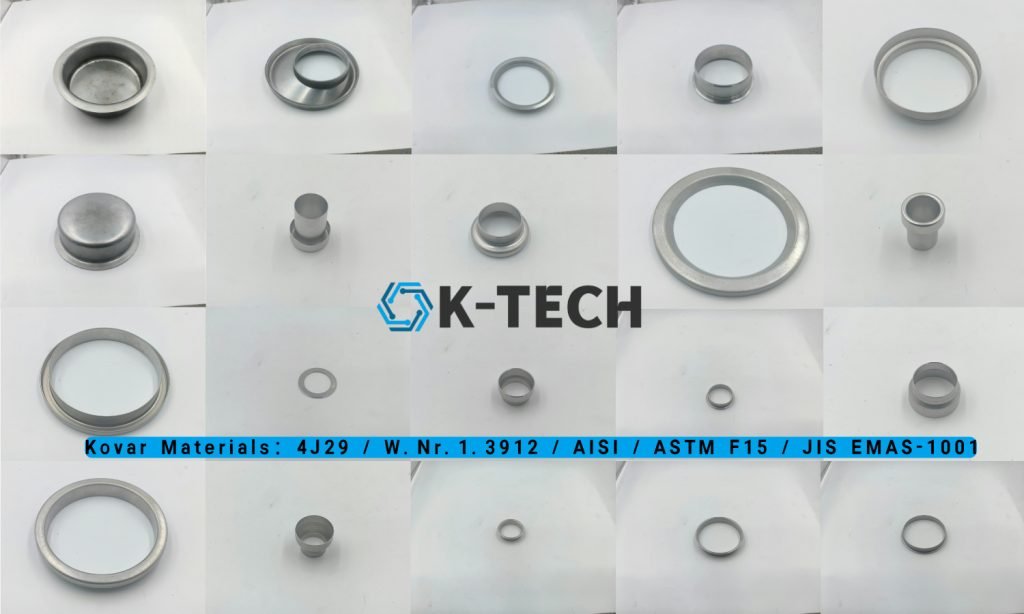
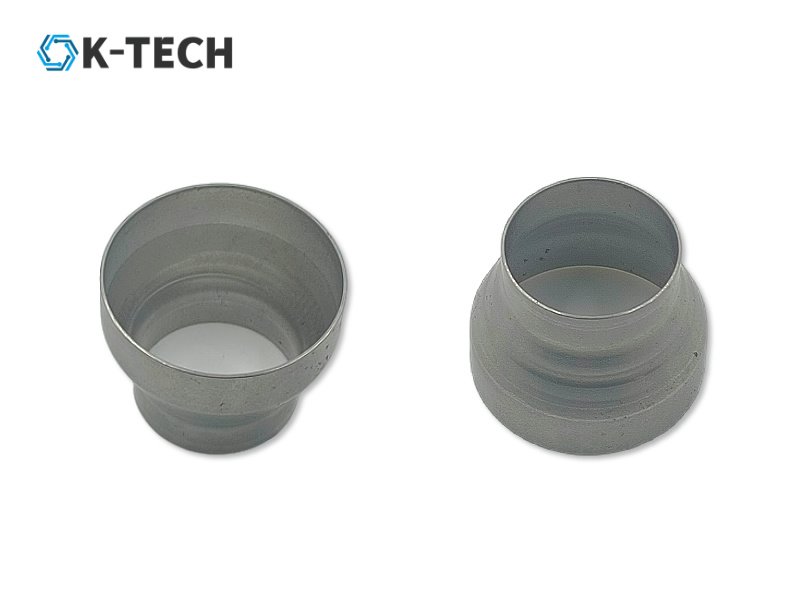
- Kovar transition sleeve: A machined or spun Kovar ring that is sealed to the glass window through a controlled oxidation and fusion process. The Kovar surface is pre-oxidized to form a thin, adherent oxide layer that the molten glass can wet, creating a chemical bond in addition to the mechanical interlock.
- Stainless steel flange: The Kovar sleeve is welded to a CF (ConFlat), KF (Kwik-Flange), or ISO flange. Because Kovar is readily weldable to stainless steel, this joint can be made leak-tight through TIG welding or brazing.
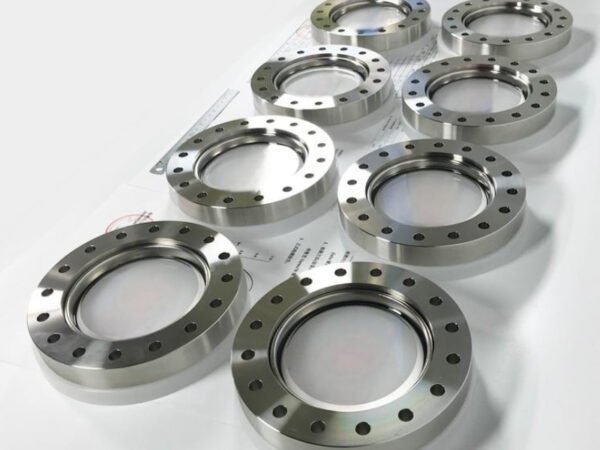
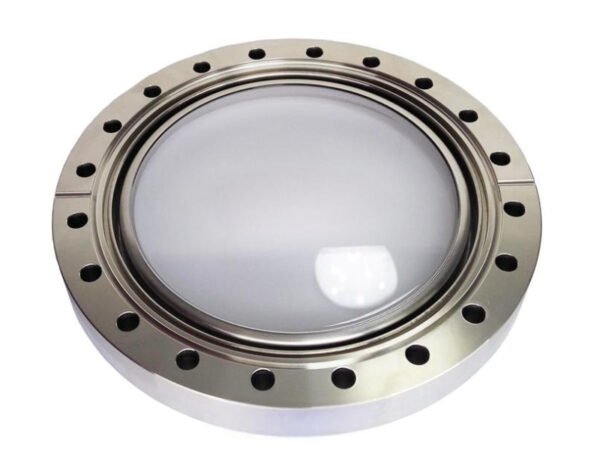
This construction is used across vacuum viewports from CF10 to CF400 sizes, supporting applications from compact laboratory chambers to large-scale semiconductor processing tools.
Performance Specifications Achievable with Kovar-Sealed Viewports
Kovar-based sealing technology enables vacuum viewports to meet demanding performance requirements:
- Ultra-low leak rate: Helium leak rates of 1 × 10⁻¹⁰ to 1.3 × 10⁻¹¹ Pa·m³/s are achievable, compatible with ultra-high vacuum environments down to 10⁻⁸ Pa.
- High-temperature bake-out: Kovar-sealed vacuum viewports can typically withstand bake-out temperatures up to 350°C, with some borosilicate configurations rated for intermittent exposure up to 550°C.
- Thermal shock resistance: The matched expansion behavior allows the viewport to tolerate temperature change rates of 25°C/min or less without compromising seal integrity.
- Long service life: The absence of residual tensile stress in the glass means the seal does not degrade through stress-corrosion mechanisms, even after repeated thermal cycling.
For applications requiring extreme temperature range or broad-spectrum optical transmission, Prekovar offers sapphire vacuum viewports with operating temperatures from -196°C to 1200°C, as well as quartz vacuum viewports optimized for UV and visible-light transmission.
Where Kovar-Sealed Vacuum Viewports Are Used
The combination of Kovar sealing and high-performance window materials makes these vacuum viewports suitable for several demanding environments:
Semiconductor manufacturing. Viewports on plasma etch chambers, CVD/PVD deposition systems, and metrology tools must maintain optical clarity through repeated thermal cycling. Kovar-sealed borosilicate vacuum viewports are a standard solution for visual inspection and optical process monitoring in these tools.
Surface science and beamlines. Synchrotron beamline endstations and surface analysis systems rely on vacuum viewports for laser entry/exit and spectroscopic access. The Kovar seal ensures that the viewport remains leak-tight through bake-out cycles required for UHV conditions.
Aerospace and space simulation. Thermal vacuum chambers used for satellite testing require vacuum viewports that can withstand rapid temperature transitions without cracking. Kovar‘s matched expansion behavior is critical in these applications.
Research and cryogenic systems. Low-temperature physics experiments and cryogenic vacuum systems benefit from Kovar-sealed vacuum viewports because the matched seal maintains integrity even when cooled to liquid nitrogen or liquid helium temperatures.
Design and Material Considerations
When specifying a Kovar-sealed vacuum viewport, several factors influence performance:
Glass selection. Corning 7056 and Kodial borosilicate are the most common choices for Kovar sealing. For UV applications, fused quartz is preferred; for high-temperature or high-pressure applications, sapphire offers superior mechanical and thermal performance but requires a different sealing approach.
Flange compatibility. Kovar sleeves are typically welded to ConFlat (CF) flanges for UHV applications, or to KF/ISO flanges for high-vacuum and rough-vacuum systems. Prekovar stocks vacuum viewports with CF flange sizes from CF10 to CF400.
Surface preparation. The quality of the Kovar-to-glass seal depends on precise control of the oxidation process. An insufficient oxide layer prevents wetting; excessive oxidation creates a weak, porous interface. Production-grade sealing requires tightly controlled furnace atmospheres and temperature profiles.
Leak testing. Every Kovar-sealed vacuum viewport should undergo helium mass spectrometer leak testing before delivery. Prekovar performs 100% helium leak detection on all viewport assemblies, with test data available upon request.
Frequently Asked Questions
Can Kovar viewports be used at cryogenic temperatures?
Yes. Because the Kovar-to-glass seal is a matched seal with minimal residual stress, vacuum viewports can be cooled to cryogenic temperatures without cracking. Prekovar’s sapphire vacuum viewports are rated for operation down to -196°C.
What is the maximum bake-out temperature for a Kovar-sealed viewport?
Borosilicate Kovar-sealed vacuum viewports typically support continuous bake-out up to 350°C. Quartz and sapphire variants can tolerate higher temperatures, up to 610°C for sapphire configurations.
Is Kovar magnetic?
Yes. Kovar is ferromagnetic below its Curie temperature of approximately 430–435°C. This should be considered in applications where magnetic fields are present near the viewport.
How does the cost of a Kovar viewport compare to alternatives?
Kovar-sealed borosilicate vacuum viewports offer the most cost-effective solution for medium to high vacuum applications. Quartz and sapphire variants cost more but provide superior optical or thermal performance. Prekovar manufactures all three types and can recommend the most suitable option based on the specific operating conditions.
Nanjing Kovar Precision Technology Co., Ltd. (Prekovar) manufactures vacuum viewports with sapphire, quartz, and borosilicate windows, all CF flange sizes from CF10 to CF400, and full helium leak testing on every assembly. Contact us to discuss your vacuum viewport requirements.